Monday, April 13, 2015

Top 5 Coffee Shops in the World (According to Andy Shaw!)

I'm not the world's greatest traveller by any measure, but I was fortunate to live in Western Australia for a little while where I discovered that espresso coffee drinks can be way better (and less bitter) than the average Starbucks in the US. Now, my blog is not to slam Starbuck's but to commend to everyone my top 5 favorite coffee shops! (By the way, I often go to Starbuck's when there's no better choice, but usually go for a dirty Chai rather than a straight espresso drink like an Americano or cappucino). Here they are in particular order...

  1. Brew Ha (Subiaco, WA) - this is where it all began. I actually remember the food was awesome too, but this is where I first started to appreciate decent espresso coffee
  2. Bloc Coffee (Cincinnati, OH) thank Siri for this one! I was visiting a wastewater treatment plant in Cincy and wanted a decent coffee. My smartphone took me to a neighborhood you wouldn't expect to see a coffee shop and there it was! This place is a gem.
  3. Latte Land Kaldis (Prairie Village, KS) - My local and an awesome coffee. This is where I ruined my colleague by introducing him to good espresso (usually an Americano). Before that he was quite happy with his McDonalds or QT drip coffee. He's not been the same since (nor has his wallet!).
  4. Dimbulah (Singapore) - whilst looking for a decent coffee shop in Singapore I stumbled on this place thinking it was a chain shipped over from Oz (there are several and all pretty darn good). It turns out that this small coffee shop chain is only in Singapore and they ship their beans from Dimbulah in Queensland. This is probably the best coffee I've ever had. My wife and niece were also spoiled by the delights of this coffee when we lived in Singapore for a few months. I think it was the coffee, or maybe the charming staff!
  5. Caribou (US Midwest) - now if I have to drink at a chain coffee shop, this is my favourite. Not sure if its the coffee or the white chocolate rasberry scones, but I was very happy when one opened near our house. Now it's just a negotiation with my wife if we go to the Starbucks which is closer or the Caribou which is better (in my mind)! Wow, these 1st world problems eh?

Enjoy the brew wherever you go! What's your fave?


Wednesday, December 31, 2014

2015

It's the season for reflecting on the past year, thinking about the New Year and maybe making a few resolutions. This past year was a little different for me in a number of ways. I've just finished a short- term assignment in Singapore with a different kind of project, in a different part of the worId, and with a different way of working. We went to a different church. It was also the year when health issues came to a head and I eventually realised that they were pretty much all linked to stress.

All of this gives me a different perspective moving into 2015 and so hopefully my resolutions have a little more weight this year:

  1. Work less - I guess a fancy way to say this is that I need a better work-life balance or that I need to work smarter. ln my case I think I just need to work less in order to redress the balance and be smarter in my work.
  2. Exercise more - me and several million others in the world I'm guessing! But my reason isn't to lose weight but, linked to the first resolution, to lower my overall stress levels. Plus I'm not getting any younger!
  3. Serve God in community - I recently read a book called Community by Brad House. It re-affirmed to me the importance of small groups in the church but added an emphasis on those groups being invested in the community. I want to be part of a group like that.
  4. Finish my PhD - I've done the coursework and written the papers. I just need to pull together my dissertation, defend it and I'm done with my degree at IIT.

And that's it. Four resolutions are plenty! Anyone else have different resolutions this year?

Happy New Year !

Tuesday, December 16, 2014

U Shaped Curves and Work-Life Balance

I'm not a sociologist, nor a psychologist. In a different blog I might open up about my opinion on the latter so-called "profession" (hint-hint) but for this blog I wanted to give some thoughts on the former. I have a growing appreciation for sociology and my favorite sociologists are probably not on anyone's list of conventional sociologists... I have a high regard for Robert Lewis and particularly his book Raising a Modern Day Knight in which he addresses the topic of raising healthy young men in the modern world. My other favourite is Malcolm Gladwell.

I recently finished reading David and Goliath in which, typical Gladwell style, he covers a myriad of topics from the London Blitz, to entrepeneurship, to school class size, and tries to tie them all together. His device for doing this was the "inverted-U". The argument goes that life is not linear and that more of something (or less of something if it's a bad thing) is not always better, but that beyond a certain point things stop getting better and actually turn downwards again. On the topic of class size he makes quite a convincing argument that there's an optimum class size somewhere in the high teens to low 20's and that going smaller doesn't work so well.

The concept of U-shaped curves or inverted-U curves resonated with me as it's common to see this in engineering where there's often an optimum point on a curve for all sorts of things... pH for biological systems, lifecycle costs of capital vs operating costs, improvement in my pool game vs number of beers I've had... OK the last one wasn't strictly engineering!

It struck me that the inverted-U could also be applied to work-life balance. It's obvious that if you're a lazy git or a "jobsworth" that does the bare minimum then you're probably not the most productive employee for a firm. What's not so obvious is that if you maximize your effort and try to do so for year after year then you might just burn out and then you're worse off than a lazy git (plus you'll have stress issues and have no life outside of work). Sure, people talk about "working smarter" instead of harder, but they still mean work more overall, I think, or at least it still seems to work out that way. The figure below puts all this into a graph.


From a personal perspective I've recently realized that I'm way too far to the right on the curve and have been that way for a couple of years now. My goal for 2015 is to figure out how to dial it back a bit and get into a sensible zone where my life is balanced and I don't burn out. How about you?


Sunday, November 16, 2014

Power made perfect in weakness

I'm currently reading Malcolm Gladwell's latest book David and Goliath. It's a fascinating read. In the first section he talks about how more and more of something is not necessarily the best thing but that an inverted "U" curve points to something more optimal, including wealth and school class size. As an engineer and modeler it makes sense to me as I often run into "U" curves that indicate a sweet spot for something.

In the second section he talks about "The Theory of Desirable Difficulty" and discusses how certain impediments and disabilities can work to your advantage in the long run. He talks about the fact that a lot of entrepreneurs are dyslexic and gives a compelling argument that their dyslexia was a big part of making them entrepreneurial!

At the start of the section he quotes the following verses from the Bible:

I was given a thorn in my flesh, a messenger of Satan, to torment me. Three times I pleaded with the Lord to take it away from me. But he said to me, "My grace is sufficient for you, for my power is made perfect in weakness." Therefore I will boast all the more gladly about my weaknesses, so that Christ’s power may rest on me. That is why, for Christ’s sake, I delight in weaknesses, in insults, in hardships, in persecutions, in difficulties. For when I am weak, then I am strong. 2 Corinthians 12:7–10

This morning I went to the local Wesleyan church to worship and the topic of the sermon was exactly the same scripture! The speaker challenged us to think about the "thorn in my flesh" that God has given us that drives us to Him and makes us depend on Him. She said it could be a physical condition, a temptation or some other difficulty in life.

For me it's either my bad sense of humour or my mental state. More likely it's the latter, as the former is more of a thorn for everyone else around me! Over the past couple of years I've slowly discovered that I don't handle stress very well. It started with a panic attack about two years ago (thankfully the only one I've had, but not fun), followed by stomach and throat issues - the doctor called it NERD, no joke - then mild heart arrhythmias last winter and finally insomnia, particularly when I had a month-long stint living alone in Singapore this summer. I remember my mum having stress related stomach issues and taking early retirement in part due to stress, I think, and as I take after my mum in many ways, it's not completely surprising that I have similar leanings.

Adding them all up I think I've had 8 out of the 11 physical symptoms of stress listed on webmd though surprisingly few of the emotional, cognitive or behavioral symptoms. You could argue that the British stiff-upper-lip means I hide things well, or maybe I just didn't notice the other symptoms!! I'd like to suggest another possibility, which is that God is the one keeping me sane! I honestly think that without God's hand on me and the Holy Spirit in me, I'd be in the loony bin or worse already. I've heard folks say that religion is for the weak-minded. In a way, I agree, because I see the fragility of my own mind and I'm extremely thankful for Christ taking hold of my weak mind to make me strong in Him (at least outwardly to others). The worst thing you can do is delude yourself that you've got it all together and don't need God at all. The best thing is to admit your weakness and let Him make you strong.

So, what's your weakness and how can God make you strong through it?

Sunday, February 2, 2014

My Faith Story

Our pastor, Dr Lou Fortier, recently gave an excellent sermon on how to present your "Faith Story" in a clear and God-honouring way. By "Faith Story" is meant the story of how someone become a Christian. So, here's my Faith Story and hopefully I've taken Lou's guidance to heart!

I grew up in England and went to a working class high school called Maryhill Comprehensive School. On a few occasions our assemblies were presented by evangelists who talked about how Jesus had died for my sins on a wooden cross and that He had risen from the dead 3 days later in order to make a way for us to have a relationship with God. They offered to pray with anyone who wanted to become a Christian. Their depiction of the Gospel resonated with me but I was afraid to make any kind of commitment because I was afraid that my friends would think I was weird. Looking back, the feeling that it "resonated," and was true, was God already calling me to trust in Him, but good old peer pressure kept me from commiting.

I left the high school at the age of 17 to go to a sixth form college where I did my A Levels. I still kept in touch with a few of my friends from high school and one in particular told me about a Christian youth group that he had started attending. I was intrigued but never went to that youth group. One Saturday we all took a train to Manchester to do some shopping and I just happened to be with two of the friends who were Christians. I saw a gathering in one of the parks and persuaded my two friends to come with me to see what the gathering was all about - politics, religion or something else. As we got closer I could see it was some kind of Christian evangelistic event and I started to feel a little uneasy. Out of nowhere, a fella came up to the three of us and in turn, starting with the friends either side of me, asked "Are you a Christian?" They both answered truthfully, yes, but when it came to me I lied by saying yes too, hoping this would end the conversation and we could leave. But, no, he had a second question that he asked each of my friends: "Are you a born-again Christian?" Again, they both answered truthfully, yes, but I couldn't lie any more because I knew I wasn't really a Christian and said "No." This fella asked me if knew Jesus had died for my sins; I said yes. He asked me if I knew that if I got knocked down by a bus whilst shopping in Manchester that I would be going to hell; again I said yes. He asked me if I would go to the front of the gathering (in the US it's commonly called an "alter call"); but I said no. He pushed me further to ask why I wasn't willing to be slightly embarassed by going to the front of the gathering when Jesus had suffered such public humilation on the cross for my sins. I didn't have a good answer but I wasn't going to budge. Then he seemed to relent a little and asked if he could pray with me; I said yes. I don't remember the words, but I do remember the feeling and the internal emotions as I prayed with this fella. I felt that God was telling me "Now or never" that it was time for me to decide to follow Him and trust Him. So finally I did trust Him by praying that simple prayer (often called "the Believers Prayer"). My pride or shyness meant that God needed to send a pushy street evangelist before I would give in to Him, but I'm forever grateful for that fella for being so direct and pushy. I don't even know his name!

So that's my Faith Story, or at least the start of it. After that I started attending the youth group with my two Christian friends and unpacked the ramifications of my simple prayer. I learned about Christian community and what it really meant to be a follower of Christ. It certainly hasn't been smooth sailing for me after becoming a Christian, but throughout the ups and downs of my life, I've never regretted the decision I made that day on the streets of Manchester. I heartily recommend it to everyone!

Saturday, November 30, 2013

Daily prayer path using memorized scripture

I have a pretty terrible memory when it comes to words and numbers. I remember things through concepts and first principles, not through raw memory retention. It was like that learning chemistry: I got the concept of the Periodic Table and so did OK in physical and inorganic chemistry, but organic chemistry was a mess of remembering a bunch of seemingly random reactions that had no rhyme or reason and so I flunked it! It's the same with sermons. Don't give me a 10-point, 5-point or even a 3-point lesson, because I won't remember the points tomorrow. Give me one clear concept and it will stick with me. I still recall Robert Lewis encouraging us to "be life-giving spirits" i.e. putting life into the world rather than sucking life out of it. THAT stuck with me. I can't for the life of me recall his definition of manhood because it has several points! (1. Reject passivity, 2. Lead courageously... 3. ...hmmm, expect God's higher reward?... I think I'm missing one - see!)

So, with this backdrop, a couple of years ago I started to memorize scripture and it took me a whole year to memorize Psalm 139! Yup, just one Psalm (but it is a pretty long one!). As part of memorizing it, at one point I put the whole Psalm into a Prezi, line by line. Then I moved to memorizing the Beatitudes and for this I used a cool mind-mapping app called iThoughtsHD. Finally I'm currently trying to memorize the start of Philippians 2, using the same tool.

Pulling this scripture into prayer is awesome once it's stuck in your noggin and so now each morning I can start my quiet time with the following 3 steps (still working on step 3 'cause it's not sticking yet!):

  1. The Beatitudes - frame my thoughts on God's economy and what's truly important in His Kingdom
  2. Psalm 139 - open my heart totally and transparently to God. Total surrender.
  3. Philippians 2:1-11 - the nuts and bolts of living out the Christian life, in Christian community and all to the glory of Jesus

Below are the Prezi and mind-maps walking through the steps...

1. The Beatitudes

2. Psalm 139

3. Philippians 2


I hope that others find these scriptures and tools useful too!


Saturday, November 2, 2013

WEFTEC 2013 Debrief (aka the post-WEFTEC blues!)

Opening Sessions

WEFTEC 2013 came and went several weeks ago, busting all sorts of records over previous years, so I'm a little tardy in giving my impression of this year's event, but here goes anyway...

Innovation Showcase

The Good

So, what were some of the highlights for me? Here in no particular order are the things that impressed me this year:

  1. The Venue: the layout of the bookstore and global meeting center right outside the entrance; the exhibition floor right underneath the rooms for the technical sessions; posters right outside the session rooms and electronic versions showing on flat-screen TVs... even a screen for tweets! The conference center was very-nicely laid out.
  2. People: I love being able to catch up with colleagues I've not seen for some time. Though I'm a technologist at heart, as I get older (cue cheezy violin music) I appreciate reconnecting with colleagues I've not seen for a while and getting to know new colleagues. You can transfer knowledge and ideas via web-based seminars, conference calls and the like, but nothing beats meeting people face to face.
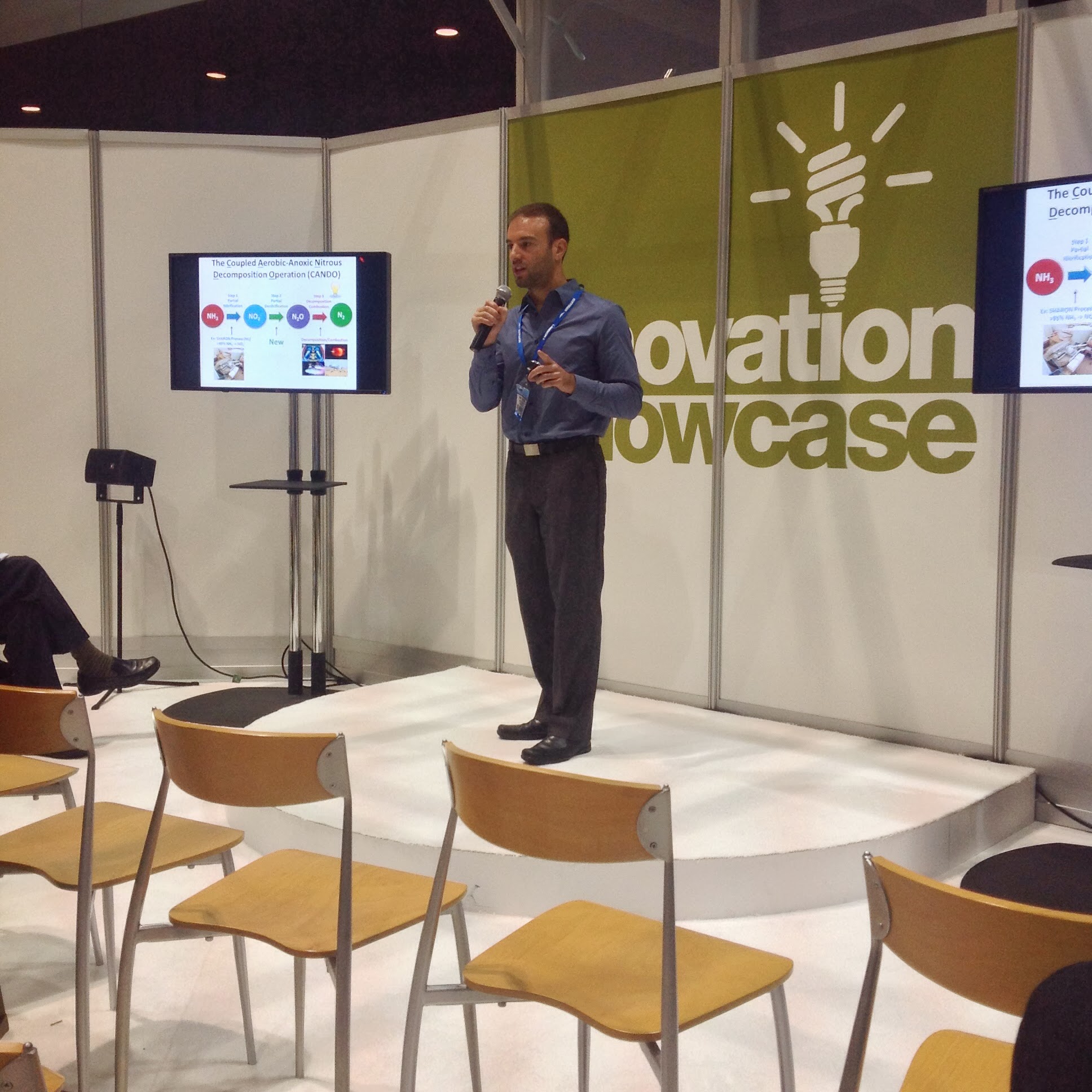
  3. Innovation Showcase: One of the few sessions I did get to attend was held at the Innovation Showcase where Yaniv Scherson presented on his CANDO process and several others presented some great and innovative ideas. There was also a session here to discuss the development of a Nutrient Roadmap, which should be pretty interesting.
  4. Workshops: I have to say I really enjoy the interactive nature of workshops versus the somewhat formal and stuffy format of technical session presentations. This year I somehow managed to help out with 3 different workshops over 2 days - sustainability, modeling and energy. I don't recommend that to anyone, but I do recommend anyone to attend workshops in the future. You learn a heck of a lot more than just watching a paper presentation.
  5. Opening sessions: I used to skip the opening sessions because I presumed they were too high level or not relevant for the kinds of things I focus on, but a couple of years back a good friend and colleague, Sudhir Murthy, encouraged me to attend an opening session and I have to say I was pretty impressed. This year's opening session and the following session by water leaders from around the world were pretty inspirational and very well done (photo at the top was the Water Leaders session).
  6. The Inaugural Bookshop Quiz! And not just because my colleagues from B&V and our client from St Cloud were the winners (see photo below). This was a bit of an experiment for WEF and by my reckoning it was an outstanding success and hope we do it again next year.
Bookshop Quiz 2014 Winners

The Not-so-good (PC term for Bad, I guess?!)

Overall WEFTEC in Chicago surpassed itself this year (are you listening New Orleans?!). So I only have a couple of nit-picky negatives that you can skip right over if you're a glass half-full kind of person (I think I'm a glass at 50% capacity person myself - figure that one out!). Here they are:

  1. Location: OK the venue is awesome, but it's too bloody far from the awesome hotels, restaurants and other delights of downtown Chicago. I hear rumours that the City has plans to build up the area around the conference center which would be great. Maybe they can add a light rail link or tram too? We stayed at the Sheraton on the north side of downtown and it was pretty cool to take the shuttle bus down some secret road under the city and down to the convention center, but I'm guessing others didn't have quite the same fun with their long queues and rush-hour bus rides back into the city.
  2. Too much to see: Maybe it's just because I'm a "Yes Man" and involved in too many things, but this year, with all the committee activities and what-not (including doing a mid-term exam - don't ask) I barely saw a handful of presentations. At some point I need to go through the proceedings and see what I missed.
  3. The submission process: This is probably a contentious one and may come across stronger than I intend, but I have issues with both the workshop submission process and the abstract submission process. The workshop submission process starts too soon (less than a month after WEFTEC), has too many steps and is contrained by an inflexible rubric that has only one format in mind. The paper abstract submission format and process used to be OK i.e. develop a 3 page Word document and a few figures. Now it's a nasty process of developing some text of indeterminate length with figures kept separate in pure graphical form, then you use some weird coding to get your figures and tables (haven't figured out a tidy way to handle tables) into the text, hopefully in the right spot. A little knowledge of html coding is helpful. Maybe this is a little unfair as it's not quite as bad as I make out as long as you know the process ahead of time. And I've never been asked to review any papers for WEFTEC so I'm hoping that maybe the new system makes the review process easier somehow.

OK, so WEFTEC 2013 is over and I'd say it was probably the best one yet. The bar is pretty high for New Orleans and WEFTEC 2014!