Tuesday, December 5, 2017

Know your source

But mark this: There will be terrible times in the last days. People will be lovers of themselves, lovers of money, boastful, proud, abusive, disobedient to their parents, ungrateful, unholy, without love, unforgiving, slanderous, without self-control, brutal, not lovers of the good, treacherous, rash, conceited, lovers of pleasure rather than lovers of God— having a form of godliness but denying its power. Have nothing to do with such people.
Not to be a doomsayer, but in the current age of "fake news," distrust of the media (rightly so in many cases), and overall disillusionment with social media, it dawned on me that a simple but obscure scripture I'd been praying for months held the key to cutting through the cacophony of voices in our modern media saturated age.  The key?  Know your source.
In 2 Timothy 3, Paul says "...evildoers and impostors will go from bad to worse, deceiving and being deceived." That sounds like the media circus we're experiencing right now.  So what does Paul say to deal with this? "But as for you, continue in what you have learned and have become convinced of, because you know those from whom you learned it..." In other words, know your source, know the people you trust, and listen to them.  Seek out people of character, who show that character by what they do and what they say. Take advice from those who are genuine and have depth.  Seek wisdom that's been proven over time.  Ignore the shallow, ignore the talking heads and shouting voices, ignore the fickle ideologies of the age.  Stop. Listen to those who make sense.
In Timothy's case, there's a specific thing he learned from his Grandma: "... from infancy you have known the Holy Scriptures, which are able to make you wise for salvation through faith in Christ Jesus. " And if you get this, then you'll start to realize that "All Scripture is God-breathed and is useful for teaching, rebuking, correcting and training in righteousness, so that the servant of God may be thoroughly equipped for every good work."
Like I said, know your source.
Photo by Ben White on Unsplash

Saturday, August 5, 2017

God's thoughts...

Most mornings I use Psalm 139 as part of my quiet time with God.  It's one of David's best psalms and packed full of heartfelt intensity and transparency before God ("Search me, God, and know my heart; test me and know my anxious thoughts." for example!)

Tucked in the middle of the Psalm in verse 17 is this line:
How precious to me are your thoughts, God!
    How vast is the sum of them!
 It's a verse that you can easily just step through and not think about too much. Maybe David just needed a nice line to bridge between talking about how God sees our unformed bodies before we're born and a call for Him to help against those who hate God? But I don't think so. The Bible says that God considered David "a man after his own heart" and so there's more to it for sure.  This guy sought after God's heart.

So what are God's thoughts?  That's what has been on my mind this past week.  Elsewhere in the Bible God says "For my thoughts are not your thoughts, neither are your ways my ways,” and "As the heavens are higher than the earth, so are my ways higher than your ways and my thoughts than your thoughts." My thoughts range all over the place from "I wonder what's for dinner?" and "I need coffee" to "I wonder if that pain in my back is cancer?" and "what picture should I use in slide 14 of my presentation next week"!! I'm sure others have their own random thoughts and threads.

But God's thoughts aren't the same as ours.  His thoughts are higher.  His thoughts are precious to David. So what are they?

In wanting to know God's thoughts, there's a new level of intimacy. We see people's actions and hear their words, but for those we love most we often wonder what they're thinking. "A penny for your thoughts" as the saying goes. Perhaps it's the same with God. We hear what he says in reading His Word and written on the tapestry of creation. We see what He did through what is written in scripture - particularly when Jesus walked the Earth - and for many we see His hand working in our lives. But what are His thoughts?

Should we ask?

Saturday, June 17, 2017

Happy Fathers' Day

I was reflecting on Fathers' Day and looking at various messages online, scriptures of encouragement and the like - all good - and it hit me that a lot of the things out there are very different from Mothers' Day messages.
On Mums' Day almost everyone says "we love you Mum" and appreciate all you do. Period. On Dads' Day there's a mix of "you're a great Dad" and a whole bunch of advice on how to be a better Dad!!! Eh? I remember one year, many moons ago, on Fathers' Day our church played "cat's in the cradle"! Deanna was ticked-off about that! So the overall story from the mix of messages on Fathers' Day is "You're a great dad, but can you do better, please? We'd appreciate it."
The other thing I saw was where there was heartfelt thanks for Dads, 9 times out of 10 it was daughters expressing their love and appreciation for their Dads, not sons.  I guess us men aren't so great at expressing our feelings (wait, I think that was in the "advice for Dads on Fathers' Day - express your feelings more ya big dolt!").
So here goes for this son expressing his appreciation for his Dad (now 89!) without offering any advice!

Letter to Dad

Dad,
I love you and I appreciate you. For all the encouraging words, for all the pats on the back, for all the times you've been there for me through good times and tough times: thank you. You mean the world to me.
Your loving son,
Andrew

Thursday, May 11, 2017

Eternal Focus in the 21st Century

"Don’t store up treasures here on earth, where moths eat them and rust destroys them, and where thieves break in and steal..."

...where the check engine light comes on, where your dishwasher won't drain, where the wifi keeps dropping and your cell-phone bill keeps going up...

"Store your treasures in heaven, where moths and rust cannot destroy, and thieves do not break in and steal. Wherever your treasure is, there the desires of your heart will also be."

"Can all your worries add a single moment to your life?"

"So don’t worry about these things, saying, ‘What will we eat? What will we drink? What will we wear?" 

...what shall I drive? What phone shall I choose? What house shall I buy?

"These things dominate the thoughts of unbelievers, but your heavenly Father already knows all your needs. 

Seek the Kingdom of God above all else, and live righteously, and he will give you everything you need."

Matthew 6:19-34

Friday, April 21, 2017

People-Projects-Profits

A couple of months back I was pondering our company's goal to grow and be more profitable. This is the goal of pretty much every business, I guess, and there's nothing wrong with it. And yet I wonder if we're missing something by focusing primarily on the money. During my pondering I penciled down an idea that motivates me and wonder if it would motivate others. It's simply:

 "People before projects before profits"


People

OK, so my main thought is that we should focus on people first.  There are two motivations for doing this with very different perspectives and so I think it covers a broad spectrum of experience:
  1. People are the ones driving the projects to ultimately generate the profits.
  2. People and human interactions are intrinsically more important than profits.
Item 1, is the business case for putting your employees, clients etc. as a primary focus so that you can drive up profits.  Southwest Airlines is the poster child for this.  Focusing on their employees, and encouraging them to be customer focused ultimately drives up profits in part because of their motivated workforce and generally happy customers.  I'm OK with this motivation, but it's not one I own, because it's really not focused on people for their intrinsic worth, but as a means to an end.  It feels like you're just using them to get what you really want aka increased profits.

So, to item 2.  Without getting to moralistic or "high and mighty" let's think about  our  daily life in general.  The majority of the working population spends 8+ hours a day working and interacting with people.  We can see this as drudgery and a means to an end to make money, pay bills, survive to the weekend etc.  OR we can see this as a significant portion of our life, where we can engage with people, enjoy the interactions, solve problems, have fun, have a positive impact on others, etc.  Now I'm blessed with have a job I enjoy, working with awesome people whereas others are not so fortunate and have to endure a job and coworkers they really don't like.  But isn't that the point of shifting our focus?  I'd hazard a guess that many of the people who're not happy in their jobs have missed the point that people are more important than just making a dollar.  A couple of years ago I was a little disheartened to chat with a coworker who'd decided to retire early.  When I asked him why he said "it's not fun any more." That's sad. I hope I never get there.

OK, so shifting back to the positive, who are the "People" within whom we interact and how could a shift in perspective energize our businesses? In a business setting, we usually think of employees and clients or customers which covers the bulk of the people with whom we interact. For sure, we should focus on having good, positive and affirming relationships with coworkers and clients.  But we should also widen the envelope to include vendors, partners, people we know through professional organizations and... dare I say it... competitors. Gasp! "Be nice to the enemy?" If the end goal is just profits, then we don't need this wider view perhaps, but looking at how we live our lives and aim to enjoy work, then we shift to civility toward everyone, including our competitors ("friendly rivalry" anyone?). 

Projects

As an engineering firm we have a strong focus on projects. Doing them well, doing them on time, doing them to a high standard. This is all good, and it's very rewarding to execute a good project.  But with this, I think we still need to keep in mind the human side of work. I have heard the expression "best for the project" used to create some really dysfunctional work/life imbalance. Doing something "for the project" misses the point if we don't keep in mind that the project is ultimately to benefit someone. It's not a thing with it's own worth or a god to which you should sacrifice your health, your relationships and your family.

Profits 

OK, I'm not naive enough to think that we can all just be nice, have fun, sing kumbaya together and all will be fine.  We do need good business sense, plans, and financial goals. But I would like to think we can decrease our emphasis on profits, profits, profits, and take time to consider people, work/life balance and the more important things in life.  Ironically, focusing on your people, should improve your projects and profits (back to the Southwest example above). In other words:

"Valued people doing projects bring profits"

And the motivation becomes a little ambiguous!

So, what motivates you?


Wednesday, December 28, 2016

Reading. Writing. Praying

As the year comes to a close it's the time to think about New Year resolutions.  There are three things I'm going to focus on for 2017: more reading, more writing and more prayer.

More Reading

"Be transformed by the renewing of your mind..."
I enjoy reading but I'm very sporadic. Sometimes I read through a book in a few days and other times I go for months stuck on the same chapter without reading anything.  Anyone who's following me on Goodreads will note I started reading "The Cost of Discipleship" by Dietrich Bonhoeffer in early November, having read an excellent and inspiring book on his life called "Bonhoeffer: Pastor, Martyr, Prophet, Spy" by Eric Metaxas.  But I'm still stuck on chapter 1, having not read it since I first started.  I could blame work, but it's more that I've been playing with my iPad too much during my downtime!  CSR2 is particularly addictive.
I also have some technical books I'd like to read, but haven't got to yet (see photo!).  In 2017 I want to soak up more spiritual, technical and fun stuff!

More Writing

"Of making many books there is no end..."
Through my career I've helped with several technical books including a fun collaboration for the called the Guidelines for Using Activated Sludge Models where I made some lifelong international friends in the Good Modelling Task Group. I also helped on several special publications and "manuals of practice" (MOPs) for the Water Environment Foundation (WEF) including their modeling publication: Wastewater Treatment Process Modeling. OK, enough for my shameless plugs for books I've worked on (I get no royalties so it's kinda pointless anyway).  I have also authored or co-authored technical papers, and, of course, blogs!
International Water Association (IWA)
So, do I need to write more?  I was reflecting on this a bit and it dawned on me that of all the things I do, writing is probably the most impactful for future generations. Not that I'm a particularly great writer, but my small impact on the world is most noticeable in whatever I leave behind in written form - in electronic written form of course! So in 2017 I want to be a little more active in blog writing and I'm even toying with a couple of ideas for fiction... yup a poop engineer thinking about writing a novel, and no, the title won't include any mention of fecal material!

More Prayer

"Pray continually..."
In recent years I've learned that my walk with God is strengthened by me spending more time with Him. The old theological term is "progressive sanctification." (And I'm no theologian so forgive me if I've misunderstood the terminology... you get my gist though). But knowing about it and doing it are totally different. It makes sense that if we want to honor God, grow in Him and follow his lead, then we need to spend time with Him in His presence.  One of the best ways to do that is to pray.  The method, the timing and the substance of the prayer may vary, but the ultimate thing is that I need to pray with "all kinds of prayers."  So in 2017, in addition to reading more, maybe writing more, I want to be praying more.  That way I'll be more in tune with Jesus and what He wants me to be focused on.

How about you? What are you going to do more in 2017?

Monday, April 13, 2015

Top 5 Coffee Shops in the World (According to Andy Shaw!)

I'm not the world's greatest traveller by any measure, but I was fortunate to live in Western Australia for a little while where I discovered that espresso coffee drinks can be way better (and less bitter) than the average Starbucks in the US. Now, my blog is not to slam Starbuck's but to commend to everyone my top 5 favorite coffee shops! (By the way, I often go to Starbuck's when there's no better choice, but usually go for a dirty Chai rather than a straight espresso drink like an Americano or cappucino). Here they are in particular order...

  1. Brew Ha (Subiaco, WA) - this is where it all began. I actually remember the food was awesome too, but this is where I first started to appreciate decent espresso coffee
  2. Bloc Coffee (Cincinnati, OH) thank Siri for this one! I was visiting a wastewater treatment plant in Cincy and wanted a decent coffee. My smartphone took me to a neighborhood you wouldn't expect to see a coffee shop and there it was! This place is a gem.
  3. Latte Land Kaldis (Prairie Village, KS) - My local and an awesome coffee. This is where I ruined my colleague by introducing him to good espresso (usually an Americano). Before that he was quite happy with his McDonalds or QT drip coffee. He's not been the same since (nor has his wallet!).
  4. Dimbulah (Singapore) - whilst looking for a decent coffee shop in Singapore I stumbled on this place thinking it was a chain shipped over from Oz (there are several and all pretty darn good). It turns out that this small coffee shop chain is only in Singapore and they ship their beans from Dimbulah in Queensland. This is probably the best coffee I've ever had. My wife and niece were also spoiled by the delights of this coffee when we lived in Singapore for a few months. I think it was the coffee, or maybe the charming staff!
  5. Caribou (US Midwest) - now if I have to drink at a chain coffee shop, this is my favourite. Not sure if its the coffee or the white chocolate rasberry scones, but I was very happy when one opened near our house. Now it's just a negotiation with my wife if we go to the Starbucks which is closer or the Caribou which is better (in my mind)! Wow, these 1st world problems eh?

Enjoy the brew wherever you go! What's your fave?


Wednesday, December 31, 2014

2015

It's the season for reflecting on the past year, thinking about the New Year and maybe making a few resolutions. This past year was a little different for me in a number of ways. I've just finished a short- term assignment in Singapore with a different kind of project, in a different part of the worId, and with a different way of working. We went to a different church. It was also the year when health issues came to a head and I eventually realised that they were pretty much all linked to stress.

All of this gives me a different perspective moving into 2015 and so hopefully my resolutions have a little more weight this year:

  1. Work less - I guess a fancy way to say this is that I need a better work-life balance or that I need to work smarter. ln my case I think I just need to work less in order to redress the balance and be smarter in my work.
  2. Exercise more - me and several million others in the world I'm guessing! But my reason isn't to lose weight but, linked to the first resolution, to lower my overall stress levels. Plus I'm not getting any younger!
  3. Serve God in community - I recently read a book called Community by Brad House. It re-affirmed to me the importance of small groups in the church but added an emphasis on those groups being invested in the community. I want to be part of a group like that.
  4. Finish my PhD - I've done the coursework and written the papers. I just need to pull together my dissertation, defend it and I'm done with my degree at IIT.

And that's it. Four resolutions are plenty! Anyone else have different resolutions this year?

Happy New Year !

Tuesday, December 16, 2014

U Shaped Curves and Work-Life Balance

I'm not a sociologist, nor a psychologist. In a different blog I might open up about my opinion on the latter so-called "profession" (hint-hint) but for this blog I wanted to give some thoughts on the former. I have a growing appreciation for sociology and my favorite sociologists are probably not on anyone's list of conventional sociologists... I have a high regard for Robert Lewis and particularly his book Raising a Modern Day Knight in which he addresses the topic of raising healthy young men in the modern world. My other favourite is Malcolm Gladwell.

I recently finished reading David and Goliath in which, typical Gladwell style, he covers a myriad of topics from the London Blitz, to entrepeneurship, to school class size, and tries to tie them all together. His device for doing this was the "inverted-U". The argument goes that life is not linear and that more of something (or less of something if it's a bad thing) is not always better, but that beyond a certain point things stop getting better and actually turn downwards again. On the topic of class size he makes quite a convincing argument that there's an optimum class size somewhere in the high teens to low 20's and that going smaller doesn't work so well.

The concept of U-shaped curves or inverted-U curves resonated with me as it's common to see this in engineering where there's often an optimum point on a curve for all sorts of things... pH for biological systems, lifecycle costs of capital vs operating costs, improvement in my pool game vs number of beers I've had... OK the last one wasn't strictly engineering!

It struck me that the inverted-U could also be applied to work-life balance. It's obvious that if you're a lazy git or a "jobsworth" that does the bare minimum then you're probably not the most productive employee for a firm. What's not so obvious is that if you maximize your effort and try to do so for year after year then you might just burn out and then you're worse off than a lazy git (plus you'll have stress issues and have no life outside of work). Sure, people talk about "working smarter" instead of harder, but they still mean work more overall, I think, or at least it still seems to work out that way. The figure below puts all this into a graph.


From a personal perspective I've recently realized that I'm way too far to the right on the curve and have been that way for a couple of years now. My goal for 2015 is to figure out how to dial it back a bit and get into a sensible zone where my life is balanced and I don't burn out. How about you?


Sunday, November 16, 2014

Power made perfect in weakness

I'm currently reading Malcolm Gladwell's latest book David and Goliath. It's a fascinating read. In the first section he talks about how more and more of something is not necessarily the best thing but that an inverted "U" curve points to something more optimal, including wealth and school class size. As an engineer and modeler it makes sense to me as I often run into "U" curves that indicate a sweet spot for something.

In the second section he talks about "The Theory of Desirable Difficulty" and discusses how certain impediments and disabilities can work to your advantage in the long run. He talks about the fact that a lot of entrepreneurs are dyslexic and gives a compelling argument that their dyslexia was a big part of making them entrepreneurial!

At the start of the section he quotes the following verses from the Bible:

I was given a thorn in my flesh, a messenger of Satan, to torment me. Three times I pleaded with the Lord to take it away from me. But he said to me, "My grace is sufficient for you, for my power is made perfect in weakness." Therefore I will boast all the more gladly about my weaknesses, so that Christ’s power may rest on me. That is why, for Christ’s sake, I delight in weaknesses, in insults, in hardships, in persecutions, in difficulties. For when I am weak, then I am strong. 2 Corinthians 12:7–10

This morning I went to the local Wesleyan church to worship and the topic of the sermon was exactly the same scripture! The speaker challenged us to think about the "thorn in my flesh" that God has given us that drives us to Him and makes us depend on Him. She said it could be a physical condition, a temptation or some other difficulty in life.

For me it's either my bad sense of humour or my mental state. More likely it's the latter, as the former is more of a thorn for everyone else around me! Over the past couple of years I've slowly discovered that I don't handle stress very well. It started with a panic attack about two years ago (thankfully the only one I've had, but not fun), followed by stomach and throat issues - the doctor called it NERD, no joke - then mild heart arrhythmias last winter and finally insomnia, particularly when I had a month-long stint living alone in Singapore this summer. I remember my mum having stress related stomach issues and taking early retirement in part due to stress, I think, and as I take after my mum in many ways, it's not completely surprising that I have similar leanings.

Adding them all up I think I've had 8 out of the 11 physical symptoms of stress listed on webmd though surprisingly few of the emotional, cognitive or behavioral symptoms. You could argue that the British stiff-upper-lip means I hide things well, or maybe I just didn't notice the other symptoms!! I'd like to suggest another possibility, which is that God is the one keeping me sane! I honestly think that without God's hand on me and the Holy Spirit in me, I'd be in the loony bin or worse already. I've heard folks say that religion is for the weak-minded. In a way, I agree, because I see the fragility of my own mind and I'm extremely thankful for Christ taking hold of my weak mind to make me strong in Him (at least outwardly to others). The worst thing you can do is delude yourself that you've got it all together and don't need God at all. The best thing is to admit your weakness and let Him make you strong.

So, what's your weakness and how can God make you strong through it?

Sunday, February 2, 2014

My Faith Story

Our pastor, Dr Lou Fortier, recently gave an excellent sermon on how to present your "Faith Story" in a clear and God-honouring way. By "Faith Story" is meant the story of how someone become a Christian. So, here's my Faith Story and hopefully I've taken Lou's guidance to heart!

I grew up in England and went to a working class high school called Maryhill Comprehensive School. On a few occasions our assemblies were presented by evangelists who talked about how Jesus had died for my sins on a wooden cross and that He had risen from the dead 3 days later in order to make a way for us to have a relationship with God. They offered to pray with anyone who wanted to become a Christian. Their depiction of the Gospel resonated with me but I was afraid to make any kind of commitment because I was afraid that my friends would think I was weird. Looking back, the feeling that it "resonated," and was true, was God already calling me to trust in Him, but good old peer pressure kept me from commiting.

I left the high school at the age of 17 to go to a sixth form college where I did my A Levels. I still kept in touch with a few of my friends from high school and one in particular told me about a Christian youth group that he had started attending. I was intrigued but never went to that youth group. One Saturday we all took a train to Manchester to do some shopping and I just happened to be with two of the friends who were Christians. I saw a gathering in one of the parks and persuaded my two friends to come with me to see what the gathering was all about - politics, religion or something else. As we got closer I could see it was some kind of Christian evangelistic event and I started to feel a little uneasy. Out of nowhere, a fella came up to the three of us and in turn, starting with the friends either side of me, asked "Are you a Christian?" They both answered truthfully, yes, but when it came to me I lied by saying yes too, hoping this would end the conversation and we could leave. But, no, he had a second question that he asked each of my friends: "Are you a born-again Christian?" Again, they both answered truthfully, yes, but I couldn't lie any more because I knew I wasn't really a Christian and said "No." This fella asked me if knew Jesus had died for my sins; I said yes. He asked me if I knew that if I got knocked down by a bus whilst shopping in Manchester that I would be going to hell; again I said yes. He asked me if I would go to the front of the gathering (in the US it's commonly called an "alter call"); but I said no. He pushed me further to ask why I wasn't willing to be slightly embarassed by going to the front of the gathering when Jesus had suffered such public humilation on the cross for my sins. I didn't have a good answer but I wasn't going to budge. Then he seemed to relent a little and asked if he could pray with me; I said yes. I don't remember the words, but I do remember the feeling and the internal emotions as I prayed with this fella. I felt that God was telling me "Now or never" that it was time for me to decide to follow Him and trust Him. So finally I did trust Him by praying that simple prayer (often called "the Believers Prayer"). My pride or shyness meant that God needed to send a pushy street evangelist before I would give in to Him, but I'm forever grateful for that fella for being so direct and pushy. I don't even know his name!

So that's my Faith Story, or at least the start of it. After that I started attending the youth group with my two Christian friends and unpacked the ramifications of my simple prayer. I learned about Christian community and what it really meant to be a follower of Christ. It certainly hasn't been smooth sailing for me after becoming a Christian, but throughout the ups and downs of my life, I've never regretted the decision I made that day on the streets of Manchester. I heartily recommend it to everyone!

Saturday, November 30, 2013

Daily prayer path using memorized scripture

I have a pretty terrible memory when it comes to words and numbers. I remember things through concepts and first principles, not through raw memory retention. It was like that learning chemistry: I got the concept of the Periodic Table and so did OK in physical and inorganic chemistry, but organic chemistry was a mess of remembering a bunch of seemingly random reactions that had no rhyme or reason and so I flunked it! It's the same with sermons. Don't give me a 10-point, 5-point or even a 3-point lesson, because I won't remember the points tomorrow. Give me one clear concept and it will stick with me. I still recall Robert Lewis encouraging us to "be life-giving spirits" i.e. putting life into the world rather than sucking life out of it. THAT stuck with me. I can't for the life of me recall his definition of manhood because it has several points! (1. Reject passivity, 2. Lead courageously... 3. ...hmmm, expect God's higher reward?... I think I'm missing one - see!)

So, with this backdrop, a couple of years ago I started to memorize scripture and it took me a whole year to memorize Psalm 139! Yup, just one Psalm (but it is a pretty long one!). As part of memorizing it, at one point I put the whole Psalm into a Prezi, line by line. Then I moved to memorizing the Beatitudes and for this I used a cool mind-mapping app called iThoughtsHD. Finally I'm currently trying to memorize the start of Philippians 2, using the same tool.

Pulling this scripture into prayer is awesome once it's stuck in your noggin and so now each morning I can start my quiet time with the following 3 steps (still working on step 3 'cause it's not sticking yet!):

  1. The Beatitudes - frame my thoughts on God's economy and what's truly important in His Kingdom
  2. Psalm 139 - open my heart totally and transparently to God. Total surrender.
  3. Philippians 2:1-11 - the nuts and bolts of living out the Christian life, in Christian community and all to the glory of Jesus

Below are the Prezi and mind-maps walking through the steps...

1. The Beatitudes

2. Psalm 139

3. Philippians 2


I hope that others find these scriptures and tools useful too!


Saturday, November 2, 2013

WEFTEC 2013 Debrief (aka the post-WEFTEC blues!)

Opening Sessions

WEFTEC 2013 came and went several weeks ago, busting all sorts of records over previous years, so I'm a little tardy in giving my impression of this year's event, but here goes anyway...

Innovation Showcase

The Good

So, what were some of the highlights for me? Here in no particular order are the things that impressed me this year:

  1. The Venue: the layout of the bookstore and global meeting center right outside the entrance; the exhibition floor right underneath the rooms for the technical sessions; posters right outside the session rooms and electronic versions showing on flat-screen TVs... even a screen for tweets! The conference center was very-nicely laid out.
  2. People: I love being able to catch up with colleagues I've not seen for some time. Though I'm a technologist at heart, as I get older (cue cheezy violin music) I appreciate reconnecting with colleagues I've not seen for a while and getting to know new colleagues. You can transfer knowledge and ideas via web-based seminars, conference calls and the like, but nothing beats meeting people face to face.
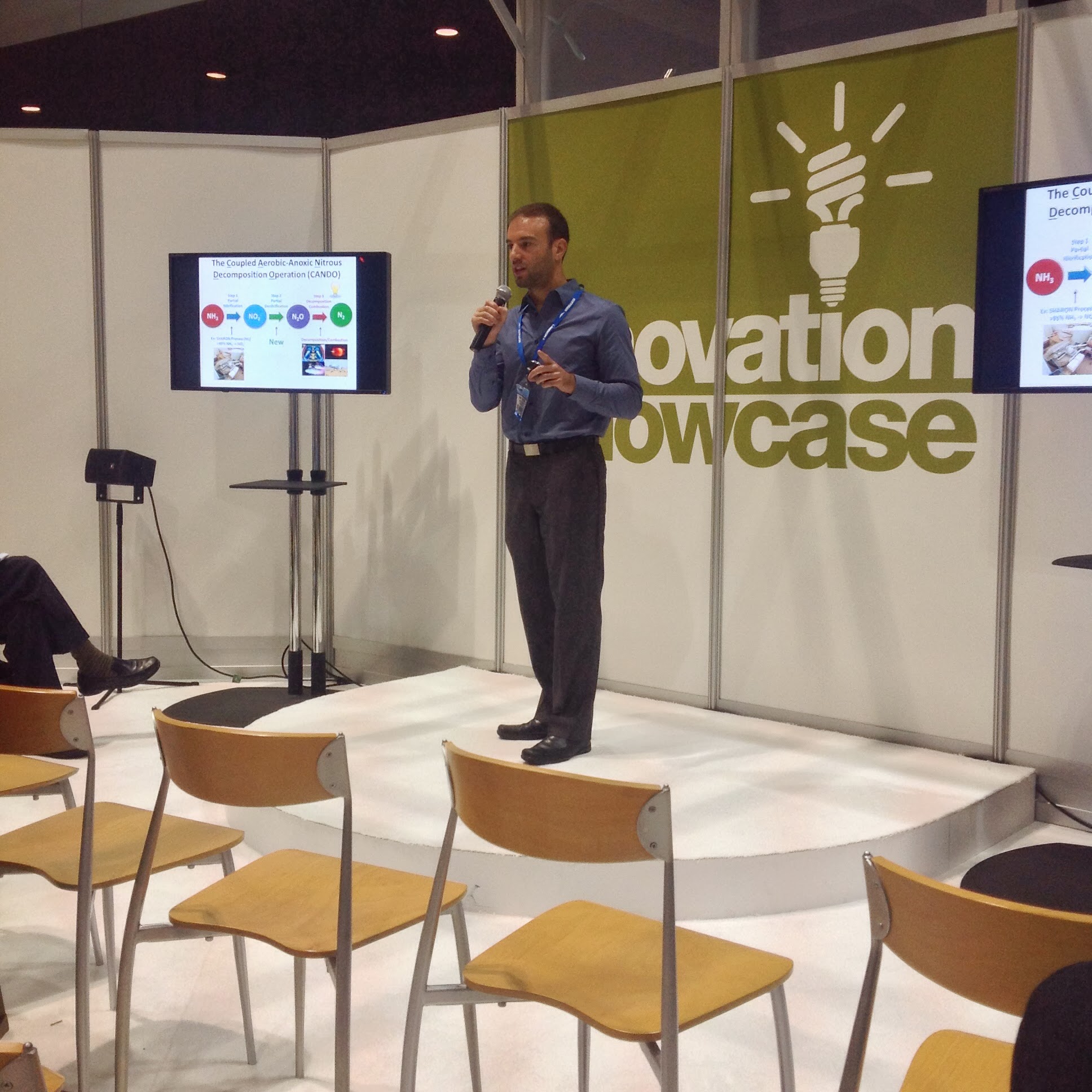
  3. Innovation Showcase: One of the few sessions I did get to attend was held at the Innovation Showcase where Yaniv Scherson presented on his CANDO process and several others presented some great and innovative ideas. There was also a session here to discuss the development of a Nutrient Roadmap, which should be pretty interesting.
  4. Workshops: I have to say I really enjoy the interactive nature of workshops versus the somewhat formal and stuffy format of technical session presentations. This year I somehow managed to help out with 3 different workshops over 2 days - sustainability, modeling and energy. I don't recommend that to anyone, but I do recommend anyone to attend workshops in the future. You learn a heck of a lot more than just watching a paper presentation.
  5. Opening sessions: I used to skip the opening sessions because I presumed they were too high level or not relevant for the kinds of things I focus on, but a couple of years back a good friend and colleague, Sudhir Murthy, encouraged me to attend an opening session and I have to say I was pretty impressed. This year's opening session and the following session by water leaders from around the world were pretty inspirational and very well done (photo at the top was the Water Leaders session).
  6. The Inaugural Bookshop Quiz! And not just because my colleagues from B&V and our client from St Cloud were the winners (see photo below). This was a bit of an experiment for WEF and by my reckoning it was an outstanding success and hope we do it again next year.
Bookshop Quiz 2014 Winners

The Not-so-good (PC term for Bad, I guess?!)

Overall WEFTEC in Chicago surpassed itself this year (are you listening New Orleans?!). So I only have a couple of nit-picky negatives that you can skip right over if you're a glass half-full kind of person (I think I'm a glass at 50% capacity person myself - figure that one out!). Here they are:

  1. Location: OK the venue is awesome, but it's too bloody far from the awesome hotels, restaurants and other delights of downtown Chicago. I hear rumours that the City has plans to build up the area around the conference center which would be great. Maybe they can add a light rail link or tram too? We stayed at the Sheraton on the north side of downtown and it was pretty cool to take the shuttle bus down some secret road under the city and down to the convention center, but I'm guessing others didn't have quite the same fun with their long queues and rush-hour bus rides back into the city.
  2. Too much to see: Maybe it's just because I'm a "Yes Man" and involved in too many things, but this year, with all the committee activities and what-not (including doing a mid-term exam - don't ask) I barely saw a handful of presentations. At some point I need to go through the proceedings and see what I missed.
  3. The submission process: This is probably a contentious one and may come across stronger than I intend, but I have issues with both the workshop submission process and the abstract submission process. The workshop submission process starts too soon (less than a month after WEFTEC), has too many steps and is contrained by an inflexible rubric that has only one format in mind. The paper abstract submission format and process used to be OK i.e. develop a 3 page Word document and a few figures. Now it's a nasty process of developing some text of indeterminate length with figures kept separate in pure graphical form, then you use some weird coding to get your figures and tables (haven't figured out a tidy way to handle tables) into the text, hopefully in the right spot. A little knowledge of html coding is helpful. Maybe this is a little unfair as it's not quite as bad as I make out as long as you know the process ahead of time. And I've never been asked to review any papers for WEFTEC so I'm hoping that maybe the new system makes the review process easier somehow.

OK, so WEFTEC 2013 is over and I'd say it was probably the best one yet. The bar is pretty high for New Orleans and WEFTEC 2014!


Saturday, April 13, 2013

From the Garden to the City

From the Garden to the City
Book Cover

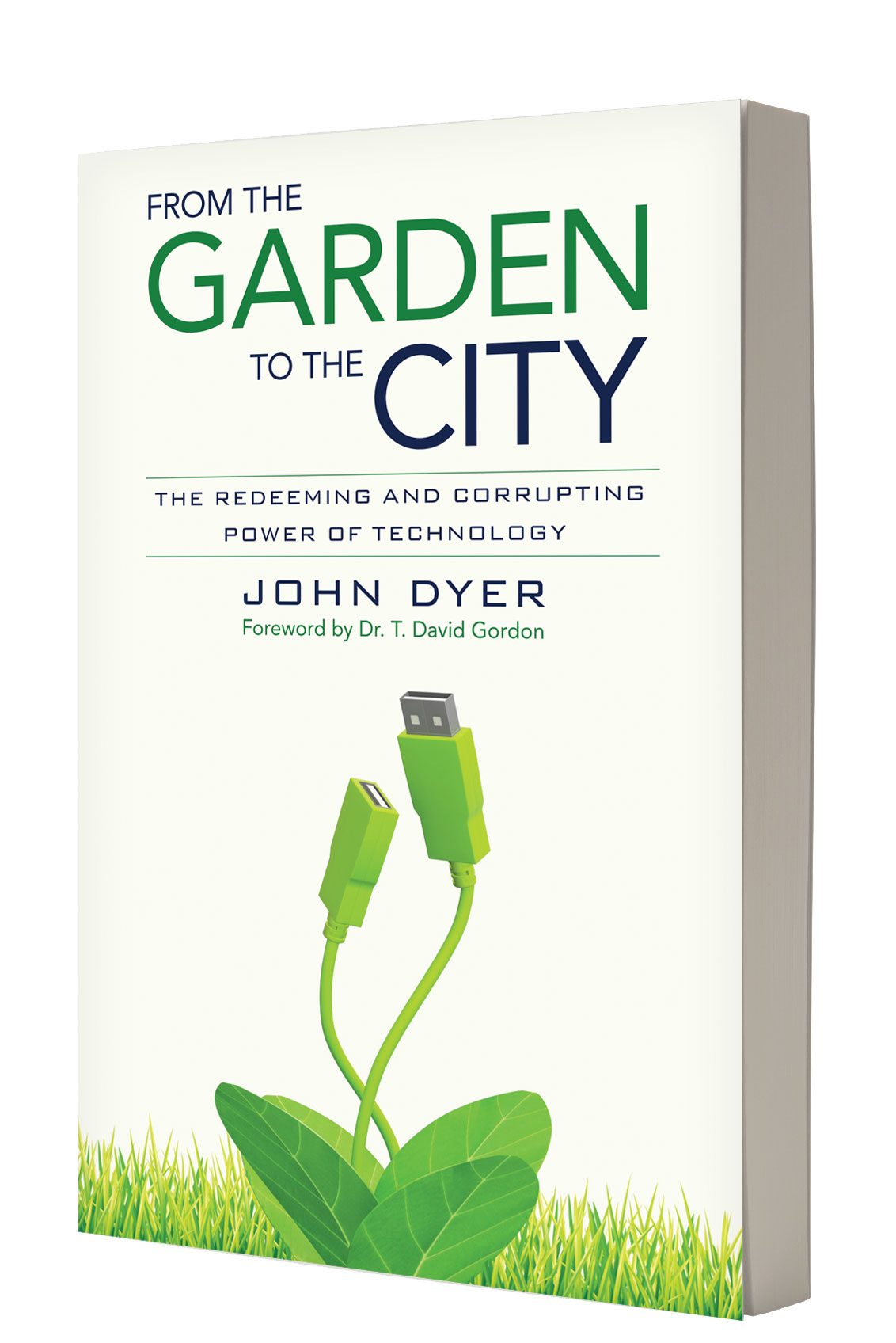
It's funny how things converge sometimes. A couple of months ago I was intrigued by a handful of reviews in the Christian Research Journal on books that address the issue of how modern technology relates to matters of faith. The book I chose was "From the Garden to the City" by John Dyer. I don't recall why I chose this particular book but I'm pretty sure it had nothing to do with the title. I'm only up to Chapter 3 in the book but it's very good. Dyer discusses how our fascination with technology and advances in technology are a kind of story where we use our imagination to think through how technology might help us do something better. He gives the basic example of a shovel. We can dig the dirt with our hands, but then using a shovel helps us do it better, quicker and more effectively. I'd never thought of technology in those terms but it makes sense. He also talks about how technology changes us. I'm early in the book yet so I'm not totally sure where he's going with this, but sitting here tapping away on my Bluetooth keyboard connected to my iPad which will wirelessly beam this blog onto the Wordl Wide Web... yeah, I can appreciate that technology has changed me!

Last weekend, I went to an interesting conference in Kansas City called CG2013, where the "CG" is for "Common Good," which, I'm told, is a concept of social justice that Pope Leo XIII addressed in his Rerum Novadum. The general idea is that Christians should be engaged in activities which promote the common good of all. Very interesting. One of the main speakers at the conference was Andy Crouch and he did a talk entitled "From the Garden to the City" (uncanny, huh?) where he talked about the fact that many Christians miss the first 2 and last 2 chapters of the Bible. They start from the description of our rebellion against God in Genesis 3 and end with Revelation 20 which describes judgement day. However, backing up to Genesis 1 & 2, there is a picture of creation in which God says "it is good" over and over and then He creates humans which he says are "very good." Then there is a description of a garden and in that garden humanity is told to work it - note all this is before the rebellion against God which means that work in itself can be a good thing. The Judeo-Christian account of creation is much more positive than the accounts in other faiths where the universe comes about through some kind of conflict or strife. Flipping to the end of the Bible and Revelation 21 & 22 we see a City. Yup, the new heaven and new earth is focussed on a massive City. Not rolling green hills. Not a bunch of people sitting on a cloud playing harps. A massive City. I'd heard this before from a book by Mark Driscoll but now at the CG2013 conference this idea has legs for me and is becoming less of an esoteric musing and something I need to think about more seriously. I guess I've also been influenced by some ideas I've seen on developing sustainable cities. I've seen presentations on ideas for Perth, WA and more recently for the Singapore International Water Week (water is a very big deal for that City). I'm still early on the learning curve but am intrigued to know more.

So, where does leave me in pondering "From the Garden to the City" and how do these two experiences shape my thinking? I guess the main thing is figuring out how to embrace technology and cities in a positive way - seeking God's redemption in both - rather than being a naysayer that sees evil in everything new. New stuff can be good. It can be very good. I see this in technology and I guess I need to start seeing this in cities too. At the same time we should not be niaive to think that all new things are good. I see plenty that's bad in many cities and there are uses of technology that are very bad (nukes for instance). Plenty to ponder!

Saturday, September 29, 2012

Comparison of Business Class Travel

OK, before we start, I'm grateful to be traveling business class and not economy. These notes are meant to convey my own personal experience traveling with different airlines and give feedback on the best of the best. Overall my experience of business class travel is very positive. Maybe some other time I'll contrast business and economy class which is a whole different story (guessing JAL will be top of the list in both categories actually, but I'm ahead of myself as usual).

OK, here is my own person run down from best to good (can't say worst as the others are all good).

  1. JAL - OK, so I'm on one of their planes typing this blog now so that may be influencing me, but I'm bowled over by their awesome customer service. The air stewardess (non PC but I forget the PC name so slap me), was very apologetic for not having the particular veggie/fish meal I wanted and made efforts to combine the meals to make sure I had something to eat. In addition, their video entertainment system has a better user interface, better screen and overall better experience than any other carrier I've flown. Japanese customer service plus Japanese Tech = ++++ experience! Well done JAL, I'm sold. As an aside, I also travelled with JAL in economy last year and their customer service was awesome - akin to what I'd expect in business class (without the leg room though!)
  2. Qantas - it has been a while since I traveled to Oz on a Qantas flight but their customer service for business class is awesome (yes sir). The seats are very comfy and conducive to sleep, relaxation or just to watch a nice movie. Now don't ask me about economy class as it's odd to see that a country that regards itself as "classless" treats the folks in the cheap seats a little less than average, but I must say their cheap seats do still have a good entertainment system.
  3. Dragon Air - this is an Asian airline based in Hong Kong and affiliated with Cathay Pacific. As such they may be classified as more of a "budget" airline but I have to say my own experience was far from budget! Their entertainment system has an awesome widescreen and their customer service was pretty good. The flight attendant (ah, now I remember the PC name!) was a little put off by me asking if I could have a non-meat meal when I hadn't pre-ordered a vegetarian meal but she wasn't rude at all and we figured something out (maybe I've become one of those difficult "high maintenance" people that I hate. Heck, I hope not - switching to vegetarian food is trickier than I thought).
  4. American Airlines - pretty decent service and good staff but their entertainment system is starting to look old with a little screen. I had to wear my glasses to watch the movies. Sorry, that's picky but for Dragon Air and JAL the screen was bigger/closer to me so I didn't need to worry about that. Also, on the flight from Dallas to Narita, the video quality was sub-par. OK to watch but when you pay extortionate fees for business class you expect better.
  5. British Airways - it has been a while, but my memory of the BA flight in business class is that the customer service was OK but that their seats were a little funky and I found it difficult to sleep. Sorry BA if my memory is failing me, but my mental list has you just below AA. Still good, and I'm not complaining, but some way to go to catch up with your Asian and Aussie colleagues.
OK, that's my totally biased opinion on business class travel. If I have a choice, the Asian airlines definitely have an edge. I've heard very good things about Singapore Airlines and Cathay Pacific but I've not had the pleasure of flying with them. Maybe next time?


Movies on a plane

Movie
Spending hours traveling on a plane is not really my idea of fun. The one plus to the long distance flights with modern entertainment systems is the chance to catch up on all the movies I've missed. Surprisingly on my flights to/from Asia this month the blockbuster fantasy and sci-fi movies that I usually enjoy were a bit disappointing whereas a couple of movies that are outside my clichéd mainstay of movies were actually very good. OK, I also enjoyed the one animated movie I watched too, just don't tell anyone (if only Noah were still 6 and I could claim I was just watching them with him)!

Here Is my rundown of the movies I watched, my marks out of 10 and brief comments:

  1. Safety not guaranteed - 10+/10. OK, if you read the description of the movie it sounds like a sci-fi, but it is most definitely not science fiction. It's about quirky people in the NW of the US interacting with each other. It's funny, quirky and a bit of a love story thrown in. Not my usual thing but I do love original movies done well and this is just that. This should win awards but I'm guessing it won't because it's too good. I recognize a couple of the actors but ask me to name them. I highly recommend to everyone.
  2. Safe house - 9/10. If I have to pick a favorite actor it would probably be Denzel Washington. He is awesome in this very original spy movie. The supporting cast are very good too. In some ways this is a formulaic spy movie but with a couple of twists and strong and convincing acting. Definitely worth a watch especially if you like the Bourne series (which I do).
  3. Brave - 8/10. OK it's an animated movie for kids but, hey, it's done well, the story is good and the characters funny throughout. There's enough "mush" to tug the heart strings but not too much that it degenerates into a soppy pile. Worth watching. Oh, the animation is impressive too if that's your thing.
  4. Prometheus - 5/10. Very disappointed. Alien 1 was good and suspenseful. Alien 2 was even better. Alien 3 was crap. Alien 4 was OK. As a prequel, Prometheus promised a lot but delivered little. Now I think about it, 5/10 is generous. I put it in the same camp as Alien 3. Sorry. The acting was very good. The special effects excellent. But the story was awful and unbelievable. Don't get me wrong, I'm all for fantasy and sci-fi but somehow the story has to me credible. At college I recall someone saying that in fiction we have to "suspend our disbelief" but if the writer is bad then they can lose us and end up with a bad book or film. The whole scene with the lead character cutting an alien out of her own body was complete and utter... to be polite I'll just say "crap." Sorry, they totally lost me at that point. My disbelief was off the scale and the plot was lost. The other elements of the film were OK if a bit tenuous. Not one I'd want to watch again.... maybe 3/10 is closer to the mark. I'll watch Alien vs Predator instead.
  5. Snow White and the Huntsman - 4/10. My wife loved this movie though I guess it's because of a certain lead character wielding an axe instead of a hammer. The acting and effects were good but, again, the story was a bit lacking. Ah well.
 

Saturday, August 11, 2012

Three Societal Objections to Evolution

In a previous blog, I listed 3 objections to the theory of evolution in its rawest form. In this current blog I turn my focus to some of the consequences of considering humanity as just a bunch of intelligent naked apes. I present 3 social or societal (sorry I'm not a sociologist, just a general observer of life) consequences of holding to this flawed theory of origins...
  1. Ultimately we answer to no-one, so anything goes. The Bible talks about the Fear of the Lord being linked to knowledge and wisdom. This isn't just a poetic phrase or a means to control the masses; it's a basic and logical truth. If you know that some day you must answer for your actions and choices in life then that influences your decisions in society and how you interact with others. Without that, who's to say you shouldn't do something? Not sure that's a wise choice for society as a whole.
  2. There is no right or wrong, just whatever works. This seems to be where the western world sits right now. There is a legacy of morality from previous generations (arguably from Christian ethics but that's another discussion!) but let's just keep what helps us to get along and throw aside the other stuff... as long as no-one gets hurt... or it's between consenting adults. Freedom for individuals to do whatever the heck they want seems to be the only moral guidance. I'm all for freedom to choose, but self-centredness and self-indulgence as a moral compass for a society doesn't bode well for civilization. Selfishness in all aspects of society can't be good for anyone in the long run.
  3. The strong should prevail and the weak be discarded. One word. Eugenics. That's the consequence of holding to evolution as an explanation for humanity. The idea fell out of favor as a social movement after World War II (the Nazi's were big fans), but expect to see genetic engineering and bio-enhancements becoming the norm as well as the potential mis-use of DNA testing to enhance human capabilities. These latter ideas are not bad in themselves but in the context of seeing ourselves as evolved apes and wanting to give evolution a boost, then anything goes.
 

Can't vote... Thankfully

I'm a foreigner (a legal alien to borrow from Sting), so I don't get to vote for your president or anyone else. I still pay taxes though, and still get to enjoy the freedoms and opportunities of this great nation. Now, for some, not being able to vote in the country in which they've lived for 10 years or so, would be a negative thing, but I have to say I'm glad I don't have to vote. American politics suck the life out of me when I think about them. The unruly mess of house, senate and judiciary at State and Federal level, the grotesque spectacle of lobbyists legally bribing politicians and the pork-barelling of bills to sneak through your own special interests without anyone noticing, all make me shake my head.

But none of these are the things that really make me glad that I don't get to vote. It's the negative ads. This campaign seems to be about what will you vote against, rather than what you will vote for. Vote against Obamacare, or vote against capitalist greed. Sad. But maybe that's what democracy is all about. For the most part the politicians try to do what's best for their country (though I suspect most do what's best for themselves or their lobbyists), so as long as they don't do anything crazy - have at it. But if they do something that does seem crazy to the masses, then they get to vote them out! Hopefully the next guy or gal will do a better job.

Still, I recall from my college education that negative ads aren't as effective as positive ads. Or maybe that was only in the UK and here in the US you're a more blood-thirsty lot! "Without vision the people perish" so it would seem that a vision means you need to be for something in politics and not just bashing the opposition, otherwise there is no way to govern or inspire people? But what do I know about politics? I'll close with this interesting note on Coke versus Pepsi. Surely the same applies to the politicians. For sure their negativity has turned me off...

Unlike politicians, companies hardly ever run negative ads. Pepsi ads don't tear down Coke; they build the brand image of Pepsi. Why? Because a tit-for-tat war of words would turn off consumers of both brands. And sales growth, not just market share, is what puts money in shareholders' pockets.

As the market leader, Coke would never give the underdog Pepsi the benefit of a mention in its ads. For its part, Pepsi would worry that negative ads against Coke would say more to consumers about the character of Pepsi than Coke. And when Pepsi did famously "challenge" Coke twenty years ago, it was with blindfolded consumers choosing between two unlabeled samples, as close as you could get to a scientific test. http://blogs.hbr.org/quelch/2008/05/how_negative_advertising_works.html


Thursday, May 31, 2012

Three Logical Objections to Evolution

I recently heard an excellent presentation by a colleague that included a slide on the evolution of the nitrogen cycle that he used to illustrate the role of archaea and anammox bacteria in the cycle. Whilst I deeply respect this colleague, his presentation highlighted one of my three intellectual reasons for considering Macro Evolution to be illogical and fundamentally flawed. He first showed an early nitrogen cycle, devoid of life, with purely chemical reactions driving the cycle. Next he showed a slightly more advanced cycle in which some basic life forms (archaea) take part in the cycle. Here's my problem... Where did these life forms come from? In his presentation they magically appear from nowhere. This is one of my main intellectual stumbling blocks for evolutionary theory. Every example seems to require a starting point that's way more advanced than evolution can explain. In other words, they need seed material.

So, here are my three intellectual objections to Evolution:

  1. No seed material. In almost all descriptions I hear of evolution, the seed material magically appears with no adequate description of where it comes from.
  2. Ecosystem complexity. Ecosystems are complex and require multiple interactions between living organisms. Take one organism out of the loop and the system breaks down. So we need more than just one seed. We need multiple and diverse seeds, right?
  3. Evolution is a strong destructive force but weak creative force. "Survival of the fittest" is an excellent mechanism for wiping out species i.e. for describing extinction, and adaptation seems a reasonable description for how species survive and thrive (though somehow they must have this resilience already built in). But the reliance on random mutations to describe the creation of new species (macro evolution) seems illogical and inadequate. I've never heard a good example given for this. All the examples I've seen were for micro-evolution and then imaginatively extrapolated to explain major intra-species changes that ultimately produce a new species. That sounds OK in a sentence but requires a lot of creative thinking to get the pieces to fit for real examples. Somehow that seems counter to the assertion that evolution is scientific. If we have to imagine so much and get artists to creatively draw stuff, that's stepping away from observation and true scientific methods too much. That is too subjective.
 

Sunday, March 25, 2012

The PC is dead. Long live the PC.

iPad 3

I saw a couple of interesting articles this week on the rise of tablet computers and the pending death of the PC. The first was a news article on the new CEO of Apple talking about the "post-PC era." Apparently they sold more iPads in the past 3 months than any single PC manufacturer sold PCs. That's a pretty radical shift in technologies.

The other article I saw was on LinkedIn and focused mostly on smart phones but also talked about tablets. They projected the global use of smartphones and tablets increasing whilst PC use stayed flat. I suspect that their extrapolations for PC use may be shaky and I could envisage a decline rather than a plateau.

The times they are a-changing... again.

I started my career in the late 80s and early 90s in the UK at a time when businesses were starting to use PCs more widely and home use of PCs was pretty rare. Though it didn't seem like it then, that was a pretty revolutionary time. Think about handwriting memos or having the typing pool type one up for you, that you could then pop in the internal mail system to have it delivered next day. I'm sure I must have done that but I honestly don't recall it. For as long as I remember, email has been ubiquitous for business communication. Similarly, spreadsheets have been the mainstay of basic engineering calcs and data presentation, and PowerPoint has been the basic tool for presenting ideas.

The subsequent couple of decades (OK now I feel old using an expression like that!) saw home use of PCs increase dramatically especially as the Internet and information age took off.

About 18 months ago my lovely wife bought me an iPad (now that the iPad 3 is out I can legitimately claim to have an "original" iPad!) I've used it for plenty of fun stuff like Angry Birds (love the new one, by the way), Words with Friends, watching TV, reading books and mags, looking at maps, studying scriptures, viewing You Tube, looking up movies, checking Facebook,... For home use the iPad is ideal and I really can't think of why I'd need a home PC. I could see that home PCs could become a thing of the past within a few years or maybe just kept around for our kids to do their homework!

21st Century Office

So it's a no-brainer that the iPad is ideally suited for home use. Also a no-brainer that it's great for keeping kids young and old entertained when traveling. The thing I haven't figured out is how the iPad and other tablet devices could change the face of business. At the end of the 20th Century it was business use that drove PC development initially and then home use came second. In the 21st Century it's possible that home use of iPads will spill over into business use that will transform the office in the future.

I use my iPad at home but I've also used it some for work. Below I list out some ways I've used my iPad for work stuff with varying degrees of success versus using my laptop.

iPad works well for...

Reading e-mail: in this I find the iPad superior to my laptop. It's more natural to swipe through an email and tap on attachments. Very nice.

Reading PDFs: similar to e-mail, it's natural and easy to use the iPad. Annotating is pretty easy too with the right app. I'm using Notability and I like it a lot. Much better than using my laptop and the basic Acrobat reader.

Giving, editing or creating presentations: I really like Keynote and the couple of times I've given presentations using my iPad it was very slick. Once it was a formal presentation and the latter it was more informal sitting around a table. This was especially cool as it's more relaxed and natural to use the iPad than booting up your laptop and having it obtrusively on the table. I have even played with creating and editing presentations and think it's actually easier and more intuitive to use your finger than using a mouse. I just wish there was an AirPlay projector so I could cut the cord. Also, I'd love to use my Prezi app but unfortunately it only works with a projector for iPad 2 or 3 and not my "original."

Looking for reference material from the Internet or "Googling": the iPad excels in this, whether you're simply using Safari or one of the many apps specifically made for the iPad, it's very convenient to pick up the iPad and look something up. I love the Wolfram Alpha app.

Checking and updating my calendar: the mobility and inobtrusiveness of iPad make it ideal to take to a meeting where you can check and update your schedule. Arguably a smartphone is even more mobile and useful in this regard but here I'm just making the case for the iPad vs laptop.

Taking notes during a meeting: I probably should have listed this earlier as its such an obvious one, but I guess I don't do this as much as I could. Having an iPad in a meeting is as inobtrusive as having a notebook and yet you have access to your emails, and other info on your device plus the Internet. You can take notes and have them stored electronically. Very nice.

iPad works OK for...

Replying to e-mail: if it's a short reply of a couple of paragraphs you're OK, but if you want to type a long reply, poking on the keyboard on screen is tedious. I guess I could invest in a Bluetooth keyboard if I seriously wanted to generate more text. I guess I could also play with voice recognition.

Editing Word documents: similar to replying to email, the various apps for editing Word documents are OK but you wouldn't want to type too much. I've also run into problems with the graphics in Word documents being messed up. Maybe sticking to simpler Word documents and getting a keyboard would allow me to do more?

Using simple spreadsheets: as an engineer I use spreadsheets a lot. I've struggled to use the Apple "Numbers" app or other apps like QuickOffice that let you edit Excel spreadsheets. If the spreadsheet is simple, it is awesome to be able to have a spreadsheet "in the field" to enter data on site or to show operators or clients some simple calcs. I haven't done much with more complex spreadsheets but maybe that will come with time!

iPad really doesn't work well for...

Creating Text Documents: unless it's a short note, simple email or a blog! Maybe I need to get a keyboard after all!

Accessing Work Documents: in typing out this blog and thinking through the biggest impediment to me using my iPad more, I realize that I have a lot of files and information on my laptop hard drive. I also have information on severs in our office and on ProjectWise, none of which I can access from my iPad. This should be an easy fix for our IT folks if there's a will to do it but I suspect that it won't happen for a few years yet. For now I get by with shifting pertinent documents over to Dropbox but that has limited capacity, I'm way too disorganized to remember to transfer files and still it doesn't help me access internal company files.

Livemeeting: not sure why but my firm uses Livemeeting and you cannot access it from an iPad. Personally I would love for us to switch to WebEx which has a great iPad app that I use for a regular call set up by one of our clients, but alas, I'm guessing that won't happen anytime soon so I'm stuck having to allow 15 - 20 minutes before any web meeting to crank up my windows laptop and get Livemeeting running.

Windows-only software: in particular I use a couple of process modeling programs, GPS-X and BioWin that are windows-based. I keep hinting that they should shift to Cloud based applications that can be accessed through a web browser, but I'm not sure how seriously they take me! I can see that as more software suppliers shift to the Cloud, this will open more opportunities to leave the laptop at home.

Excel Spreadsheets with Graphs: not sure why, but the graphs don't come across into Numbers or most of the other apps I've tried. Some formulas don't work either I'd guess and I'm not sure about pivot tables as I've not tried transferring any.

Creating emails with attachments: OK now Apple, this one is just plain weird. Why have a device that's probably the best way to access email and not provide the ability to attach documents? Please fix this! You can send emails from within various apps with a file attached from that app, but say you want to send 1 email with, say, a Pages file and a Keynote presentation that goes with it, then you're out of luck. Unless there's a way and I've just not figured it out?

The future is bright and much lighter!

I travel a lot and I find using my iPad ideal for most of my needs whilst on the road. But still I have to lug my heavy laptop around for the few but vital things I cannot yet do without it. I'm hopeful that many of the impediments to wider iPad use I've noted here will be overcome in the not too distant future. Then I'll be happy to say "the old PC is dead, long live the new PC" (aka a tablet-style "Personal Computer"!)